What Is Light Spectrum and Its Impact on Vegetable Growth?

Time:2026-09-17 Author:Aria
0%

Light is more than brightness in a vegetable greenhouse. It is information, energy, and a daily signal for plant development. In controlled environments, leaves respond to different wavelengths through photosynthesis, photomorphogenesis, and flowering regulation. So, How does light spectrum affect vegetable growth? The answer depends on crop type, growth stage, canopy density, and daily light exposure.

The U.S. Department of Energy’s 2023 Solid-State Lighting R&D Opportunities report identifies photon efficacy, lighting controls, and application efficiency as major priorities for horticultural LEDs. This matters because electricity can become a significant operating cost when fixtures run above a crop canopy every day. The USDA’s 2022 Census of Agriculture also documents expanding protected-culture production, while showing that production conditions differ widely by region and facility. One recipe cannot serve every farm.

At canopy level, blue light often supports compact growth, stronger leaves, and stomatal activity. Red light drives efficient photosynthesis and can support biomass accumulation. Far-red light may influence stem extension and shade responses. These effects are real, but they are not isolated. Spectrum interacts with PPFD, photoperiod, temperature, humidity, and carbon dioxide. That is the difficult part.

Growers often inspect lettuce under white LEDs, then compare leaf thickness, internode length, color, and fresh weight. Small changes can matter. Yet the picture is not perfectly tidy. A spectrum that improves basil may stretch tomatoes or alter cucumber flowering. Reliable decisions therefore require cultivar trials, calibrated sensors, and repeated harvest records. This introduction examines the science, practical data, and limits behind modern vegetable lighting. It offers guidance, not a universal recipe.
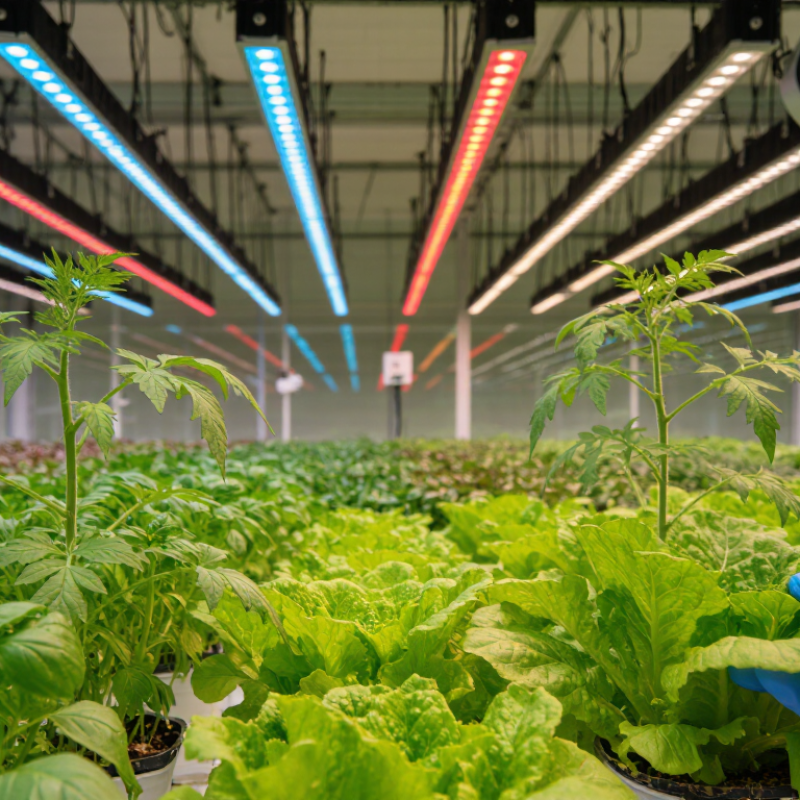
What Is Light Spectrum and Its Impact on Vegetable Growth?

Light Spectrum: Definition and Main Wavelength Ranges

Light spectrum is the complete range of electromagnetic radiation, measured by wavelength. Plants respond mainly to visible light, roughly from 400 to 700 nanometers. This range is called photosynthetically active radiation, or PAR. Light quality affects photosynthesis, leaf shape, flowering signals, and plant height. Brightness alone does not explain plant performance.

Blue light spans approximately 400–500 nanometers. It supports compact growth, strong leaves, and healthy chlorophyll formation.

Green light covers about 500–600 nanometers. Leaves reflect some green wavelengths, but they also absorb and use them, especially inside dense canopies.

Red light, around 600–700 nanometers, strongly supports photosynthesis and biomass production.

Far-red light, approximately 700–750 nanometers, influences shade responses. Plants may stretch when far-red energy becomes high compared with red energy.

Ultraviolet light sits below 400 nanometers, while infrared begins beyond the visible range and mainly contributes heat.

The picture is not perfectly neat. Wavelength boundaries can vary between research papers and measurement systems.

In greenhouse observations, seedlings under excessive blue light may remain short but develop smaller leaves. Under heavy red light alone, some vegetables can become tall or structurally weak.

A balanced spectrum usually works better, though “balanced” depends on crop, growth stage, temperature, and leaf density.

A simple spectrometer can reveal whether a lamp delivers the advertised ranges, but it cannot measure plant response by itself. Watch the crop closely. Leaf angle, stem length, color, and fresh weight often reveal problems that a light chart misses.

How Plants Detect and Use Different Light Wavelengths

What Is Light Spectrum and Its Impact on Vegetable Growth?

Plants do not simply “see” light as people do. They measure wavelength, intensity, duration, and direction through specialized photoreceptors. Chlorophyll absorbs mainly blue light around 400–500 nanometers and red light near 600–700 nanometers. These wavelengths support photosynthesis, leaf expansion, and carbohydrate production.

Blue light activates cryptochrome and phototropin receptors. It can produce shorter stems, wider leaves, and stronger early growth. Red light drives efficient photosynthesis and influences flowering signals. Far-red light, near 730 nanometers, changes the red-to-far-red ratio. When plants sense more far-red light, they may stretch as if competing for sunlight. The response is useful, but not always desirable in compact vegetable production.

Professional lighting data shows why spectrum cannot be separated from energy management. The U.S. Department of Energy’s 2023 solid-state lighting report recorded horticultural LED efficacies approaching 3.0 micromoles per joule, compared with about 1.7 for high-pressure sodium systems. Crop-lighting guides from university extension services commonly place leafy greens near 12–17 mol/m²/day of daily light integral, while fruiting vegetables may require 22–30 mol/m²/day. These figures are practical starting points, not guarantees. Temperature, nutrition, cultivar, and canopy density can change the outcome. I have seen bright blue lighting produce compact plants with disappointing mass. More light is not automatically better.

Light Spectrum Effects on Photosynthesis and Vegetable Growth

Light spectrum directly shapes photosynthesis and vegetable growth. Chlorophyll uses red and blue light efficiently, driving carbon fixation and leaf development. Blue light often supports compact plants, stronger leaves, and controlled stem stretching. Red light can improve photosynthetic output when other conditions remain suitable. Green light is not useless. It can travel deeper into dense leaves, where lower foliage still receives energy.

I once treated spectrum as a fixed recipe. That was too simple. Light intensity, daily exposure, temperature, water, and nutrition change the result. Excessive intensity can damage photosynthetic tissues and cause pale, curled leaves. Far-red light may encourage stem elongation, especially when plants sense shade. In leafy vegetables, that response can reduce marketable quality. Fruiting crops may respond differently, so one setting rarely fits every stage.

Tips: Watch the newest leaves each day. Measure light near the canopy, not above it. Compare plants under similar moisture and temperature conditions. Adjust one factor at a time, even if growth looks slow. A simple weekly record of leaf color, height, and fresh weight can reveal patterns that eyesight misses. Do not chase deeper color alone; darker leaves do not always mean faster growth.

What Is Light Spectrum and Its Impact on Vegetable Growth? - Light Spectrum Effects on Photosynthesis and Vegetable Growth

Spectral Region Approximate Wavelength Main Plant Response Photosynthesis and Growth Effects Vegetable Examples
Ultraviolet-A 315–400 nm Stress signaling and protective compound production Usually contributes little to photosynthesis; excessive exposure can cause leaf damage, while controlled exposure may increase some phenolic compounds. Lettuce, basil, spinach
Blue 400–500 nm Leaf formation, stomatal opening, and compact growth Strongly absorbed by chlorophyll; supports photosynthesis and helps regulate plant shape. Too much blue relative to other wavelengths may reduce leaf expansion. Lettuce, kale, cucumber seedlings
Green 500–600 nm Light penetration into the canopy Chlorophyll absorbs less green light than red or blue, but green wavelengths can penetrate deeper into leaves and contribute to photosynthesis in lower canopy layers. Tomato, pepper, lettuce
Orange 600–620 nm Efficient photosynthetic activity Absorbed by photosynthetic pigments and can complement red and blue light in a balanced spectrum. Leafy greens, tomato, bean
Red 620–700 nm High photosynthetic efficiency and biomass production Strongly absorbed by chlorophyll and often supports leaf area, stem elongation, and dry-matter accumulation. Red light alone can produce elongated, less compact plants. Tomato, cucumber, lettuce
Far-Red 700–750 nm Shade-avoidance signaling and plant architecture Has limited direct photosynthetic value compared with visible light but strongly affects the phytochrome system, including stem elongation and flowering responses in some crops. Lettuce, bean, tomato
Near-Infrared Above 750 nm Thermal and morphological effects Does not substantially drive oxygenic photosynthesis; excessive energy can increase leaf temperature and water loss. All vegetables, depending on exposure
Practical interpretation: Vegetable growth depends on the total photosynthetic photon flux density, photoperiod, plant temperature, water availability, carbon dioxide concentration, and the balance among wavelengths. A broad spectrum containing blue and red light, with appropriate green and far-red proportions, generally supports more balanced growth than relying on a single wavelength.
Note: Wavelength ranges and plant responses are approximate. Cultivar, developmental stage, light intensity, and environmental conditions can change the observed results.

Choosing Suitable Light Spectra for Different Vegetables

Light spectrum describes the colors, or wavelengths, emitted by a grow light. Plants use these wavelengths differently during photosynthesis and development. Blue light supports compact leaves, strong stems, and dense growth. Red light drives efficient photosynthesis and often encourages flowering and fruit production. Far-red light can influence stretching and flowering, but excessive amounts may produce weak stems.

Different vegetables need different spectral balances. Lettuce, spinach, and kale usually perform well under a moderate mix of blue and red light. More blue light can keep leafy crops short and sturdy. Tomatoes, peppers, and cucumbers generally benefit from strong red light during flowering and fruiting. However, they still need blue wavelengths for healthy leaves. Root vegetables, such as radishes and carrots, need balanced light rather than an extremely red spectrum. Their edible roots develop below the soil, so leaf health remains important.

A practical grower should observe leaf color, stem length, and the distance between leaves. Pale leaves may indicate inadequate light, while long, thin stems often suggest weak intensity or too much far-red light. Light duration also matters. Spectrum alone cannot fix poor watering or high temperatures. A common mistake is changing the light color too quickly. My early preference was to use more red light for faster growth, but the plants became less compact. I now adjust spectrum gradually and record plant responses each week. Even reliable guidelines need testing under local temperature, humidity, and cultivar conditions.

Managing Light Intensity, Duration, and Plant Growth Responses

What Is Light Spectrum and Its Impact on Vegetable Growth?

Light spectrum describes the colors of light reaching a plant. Each wavelength can influence photosynthesis, leaf shape, and flowering behavior.

Blue light often supports compact leaves and sturdy stems. Red light can promote efficient photosynthesis and reproductive growth. Far-red light may trigger stretching when plants sense nearby competition. Green light is not useless; it can reach deeper leaves inside a dense canopy.

Intensity and Duration

Intensity and duration must work together. I measure light at the leaf surface, not above the lamp. A bright source may still create uneven exposure across a growing tray.

Excessive intensity can cause pale edges, curling, or dry patches. Too little light often produces thin stems and long spaces between leaves. Small seedlings usually need gentler light than mature crops. They also need a gradual increase.

Photoperiod and Plant Response

Photoperiod changes how plants use that intensity. A consistent timer helps prevent irregular growth and unnecessary stress.

I once extended the lighting period for leafy greens, expecting faster harvests. The plants grew larger, but their leaves became tougher than expected. That result reminded me that more light is not always better.

Temperature, water, nutrition, cultivar, and canopy spacing can change the response.

Record daily light exposure, plant height, leaf color, and moisture. Adjust one factor at a time. Growth data can challenge assumptions.

FAQS

What is the light spectrum?

The light spectrum is the complete range of electromagnetic radiation measured by wavelength. Plants mainly use visible light from 400 to 700 nanometers. This range is called PAR.

How does blue light affect vegetable growth?

Blue light, around 400–500 nanometers, supports compact stems, strong leaves, and chlorophyll formation. Too much blue light may keep seedlings short with smaller leaves.

What does red light do for plants?

Red light, near 600–700 nanometers, supports photosynthesis and biomass production. It often helps flowering and fruit development. Red light alone can produce tall, weak plants.

Why is far-red light important?

Far-red light, around 700–750 nanometers, affects shade responses. A high far-red level compared with red light may trigger stretching. This can create wider gaps between leaves.

Which spectrum suits leafy vegetables?

Lettuce, spinach, and kale usually respond well to moderate blue and red light. More blue light can keep these crops short and sturdy. Watch leaf size, color, and stem strength.

What lighting balance works for fruiting vegetables?

Tomatoes, peppers, and cucumbers generally benefit from strong red light during flowering and fruiting. They still need blue light for healthy leaves. A red-heavy setup may reduce structural strength.

Do root vegetables need a special spectrum?

Radishes and carrots usually need balanced light rather than an extremely red spectrum. Healthy leaves support root development below the soil. Spectrum alone cannot solve poor watering.

How much daily light might vegetables need?

Leafy greens often perform near 12–17 mol/m²/day of daily light integral. Fruiting vegetables may need about 22–30 mol/m²/day. These figures are starting points, not guarantees.

Can a spectrometer prove that plants will grow well?

A simple spectrometer can show emitted wavelength ranges. It cannot measure plant response by itself. Check leaf angle, stem length, color, and fresh weight each week. Light charts miss details.

Conclusion

Light spectrum refers to the range of wavelengths in light, including ultraviolet, visible colors, and far-red radiation. Plants detect these wavelengths through specialized pigments and photoreceptors, using the information to regulate photosynthesis, leaf development, flowering, stem elongation, and other growth processes. Blue light generally supports compact growth, strong leaves, and healthy chlorophyll formation, while red light efficiently drives photosynthesis and can influence flowering and fruit production. Green light can penetrate deeper into plant canopies, and far-red light affects shade responses and plant shape.

How does light spectrum affect vegetable growth? Its influence depends on the vegetable species, growth stage, light intensity, and daily exposure time. Leafy vegetables often benefit from balanced blue and red light, while fruiting vegetables may require carefully adjusted red and far-red proportions during later development. Managing intensity and duration is equally important: excessive light can cause stress, whereas insufficient light may produce weak, elongated plants. A suitable spectrum, combined with proper timing and intensity, helps improve growth, quality, and resource efficiency.

Aria

Aria

Aria is a dedicated marketing professional with a deep passion for innovative strategies and a keen understanding of our company's product offerings. With a wealth of experience in the industry, Aria excels at crafting engaging content that highlights the unique features and benefits of our......