Replacing an indoor grow light is not simply a calendar decision. It depends on photon output, heat exposure, operating hours, and plant response. This matters when comparing China’s top 10 indoor grow light suppliers. A low-priced fixture may look efficient, yet its diodes can lose performance faster under poor cooling.
So, when should I replace my indoor grow light bulbs? The U.S. Department of Energy reports that quality LED products commonly reach 25,000 to 50,000 hours of useful life, depending on operating conditions. However, “useful life” does not mean the lamp suddenly stops working. It usually refers to gradual lumen depreciation. For horticulture, PPFD decline is more important than visible brightness. A 2023 report from the DesignLights Consortium also emphasizes testing, thermal management, and reliable performance data for horticultural fixtures.
Dr. Bruce Bugbee, a recognized plant-lighting researcher, has stated, “Plants respond to photons, not watts.” That principle should guide replacement decisions. Measure canopy PPFD when possible. Watch for stretched stems, uneven flowering, dark corners, flickering, or unusually hot housings. A practical replacement point may arrive before total failure, especially after several growing cycles. Still, this is not universal. Some fixtures remain effective for years, while cheaper bulbs degrade early. Supplier claims should be checked against LM-80, TM-21, warranty terms, thermal tests, and independent performance reports. The most reliable choice is rarely the brightest box. It is the fixture that maintains stable light where plants actually grow.
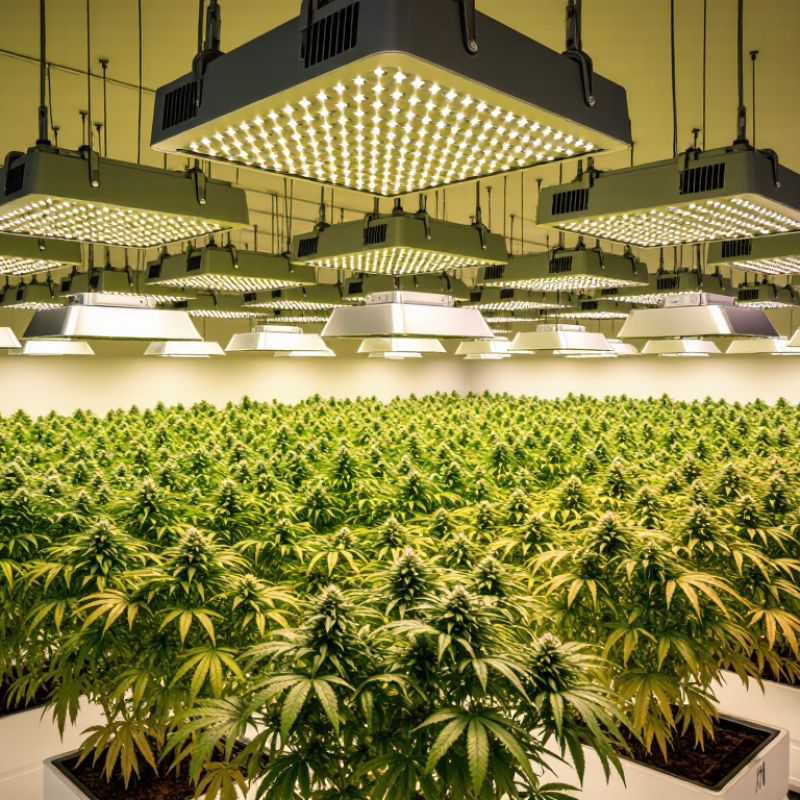
Indoor grow lights are engineered lamps that supply plants with usable light when sunlight is weak, limited, or unavailable. Their performance is measured by PPFD, PPF, and spectrum, not by brightness alone. PPFD shows the light reaching each square meter, while PPF measures total plant-useful light. This distinction matters. A bright lamp can still produce uneven growth.
The International Energy Agency reports that lighting uses about 15% of global electricity. The U.S. Department of Energy also states that LED lighting can use at least 75% less energy and last up to 25 times longer than incandescent lighting. However, a grow light may lose useful output before it stops working. Heat, dust, driver failure, and declining diodes can reduce PPFD. Replace it when measured output falls near 70% of its original level, or when plants show stretched stems and uneven leaf development. A calendar date is helpful, but not enough. I have seen lights look normal while delivering weak coverage.
Tips: Record PPFD when the lamp is new. Measure the same points every three to six months with a calibrated meter. Clean vents and lenses carefully. Replace the unit if flickering, dark zones, excessive heat, or unstable output continues. The DOE’s Solid-State Lighting reports stress thermal management, yet many growers still ignore it. That is an avoidable mistake.
Evaluating China’s top 10 indoor grow light suppliers requires more than comparing wattage or factory photos. Ask for independent reports showing PPF, PPE, spectrum, thermal performance, and PPFD uniformity. The DesignLights Consortium’s Horticultural Lighting Technical Requirements emphasize verified photon output, safety, dimming, and product documentation. These details expose weak claims quickly.
Use practical tests. A supplier should provide an integrating-sphere report, an IP rating, electrical safety certificates, and a clear warranty process. Check whether the report covers the exact model, not a similar prototype. The U.S. Department of Energy’s Solid-State Lighting research reports identify thermal management as a major factor in LED performance and lifetime. Therefore, inspect heatsink size, driver temperature, ventilation, and replacement parts.
Replacement decisions also need measurable evidence. Compare current PPFD readings with the original commissioning record. A 10–20% decline may justify investigation, especially when crops show uneven growth or darker canopy zones. However, this threshold is not universal. I have seen lights remain electrically functional while losing useful output through dust, heat, or driver aging. That is easy to miss. Suppliers should explain lumen or photon-maintenance testing, preferably with LM-80 and TM-21 evidence where applicable. Price still matters, but traceable data, responsive technical support, and consistent batch quality deserve heavier scores than attractive catalog numbers.
This anonymous comparison uses practical purchasing criteria for indoor horticultural LED lighting. Supplier identities and brand information are intentionally excluded. Technical figures should be confirmed through current datasheets, independent laboratory reports, product samples, and factory audits before purchasing.
| Supplier Profile | Typical Product Focus | Typical Input Power | Reported PPF Range | Target Efficacy | Warranty Range | Safety & Compliance Evidence | Manufacturing Evaluation | Replacement Indicator | Evaluation Score |
|---|---|---|---|---|---|---|---|---|---|
| Supplier Profile 01 | Full-cycle bar-style fixtures | 480–720 W | 1,300–2,300 µmol/s | 2.7–3.2 µmol/J | 3–5 years | Documents available | Stable model range; sample testing recommended | Replace when output falls below 80% of the original specification | 89 |
| Supplier Profile 02 | Compact commercial panels | 240–480 W | 650–1,450 µmol/s | 2.5–3.0 µmol/J | 3–5 years | Documents available | Good customization capability; verify thermal design | Replace if driver noise, flicker, or excessive heat appears | 86 |
| Supplier Profile 03 | High-output greenhouse fixtures | 720–1,000 W | 2,000–3,200 µmol/s | 2.6–3.1 µmol/J | 3–5 years | Verify by model | Strong output potential; inspect IP rating and connectors | Replace when corrosion, water ingress, or repeated shutdown occurs | 84 |
| Supplier Profile 04 | Vertical-farm multi-layer lights | 40–200 W | 100–620 µmol/s | 2.3–2.9 µmol/J | 2–5 years | Documents available | Suitable for compact systems; assess uniformity carefully | Replace if light uniformity becomes uneven across growing tiers | 82 |
| Supplier Profile 05 | Adjustable-spectrum fixtures | 300–650 W | 800–2,000 µmol/s | 2.4–3.0 µmol/J | 3–5 years | Verify by model | Flexible spectrum control; confirm control-system compatibility | Replace if spectrum channels fail or intensity control becomes unstable | 78 |
| Supplier Profile 06 | Water-resistant greenhouse bars | 100–500 W | 280–1,500 µmol/s | 2.4–2.9 µmol/J | 3–5 years | Documents available | Useful for humid environments; verify sealing and cable glands | Replace after seal damage or when moisture reaches the driver | 80 |
| Supplier Profile 07 | Budget indoor grow panels | 100–300 W | 220–800 µmol/s | 2.0–2.6 µmol/J | 2–3 years | Partial evidence | Competitive pricing; check component consistency between batches | Replace when energy use rises without maintaining the required PPFD | 73 |
| Supplier Profile 08 | Private-label modular fixtures | 240–720 W | 650–2,300 µmol/s | 2.5–3.1 µmol/J | 3–5 years | Verify by model | Good OEM flexibility; require change-control documentation | Replace if replacement parts or matching drivers are no longer available | 76 |
| Supplier Profile 09 | Low-profile propagation lights | 25–150 W | 60–430 µmol/s | 2.2–2.8 µmol/J | 2–5 years | Documents available | Appropriate for seedlings; confirm dimming range and coverage | Replace when measured PPFD is insufficient for the crop stage | 79 |
| Supplier Profile 10 | Heavy-duty high-ceiling fixtures | 800–1,200 W | 2,200–3,800 µmol/s | 2.6–3.2 µmol/J | 3–5 years | Obtain independent proof | High performance potential; inspect thermal management and driver sourcing | Replace after repeated thermal protection events or unsafe electrical damage | 75 |
When comparing China’s top indoor grow light suppliers, product reliability matters more than attractive specifications. A dependable fixture should publish tested PPFD maps, not only wattage claims. Its light output must remain even across the growing area, with stable spectrum performance over time. Good thermal design is essential. Aluminum heat sinks, quiet fans, and protected drivers help prevent heat damage. No fixture is perfect.
Check the driver, wiring, and housing carefully. Reliable products often include clear electrical ratings, safety certifications, and a practical warranty. An IP-rated enclosure can reduce risk in humid rooms, but it does not excuse poor installation. Look for replaceable components, accessible manuals, and responsive technical support. These details reveal whether a supplier understands long-term use. A low purchase price may become expensive when repairs are impossible.
Tips: Record canopy temperature and light intensity every few months. Replace a fixture when output drops noticeably, flickering begins, or cooling becomes noisy. Yellowed lenses, brittle cables, and dark diode patches also deserve attention. Compare readings with the original PPFD map when available. I would avoid replacing lights by age alone; growing conditions, daily runtime, and heat exposure change the timeline. Sometimes the problem is mounting height, not the lamp. That mistake is common.
Indoor grow lights should be replaced based on performance, not a calendar alone. In my experience, plants often reveal decline before the fixture fails. New leaves become smaller, stems stretch, and the canopy develops uneven growth. A simple PPFD reading can confirm whether light intensity has dropped. Compare readings at the same height and location each month. If output falls roughly 20 to 30 percent, replacement deserves serious consideration. The exact threshold depends on crop needs, room temperature, and electricity costs.
Inspect the fixture every few weeks. Darkened diodes, flickering, buzzing, cracked housings, and burnt smells are warning signs. Stop using damaged equipment until a qualified technician checks it. Heat matters too. Dust on vents can raise operating temperature and shorten driver life. Clean only after switching off and unplugging the unit. Moisture near electrical connections is another reason to replace the fixture, not merely wipe it. A timer that drifts can create inconsistent lighting, although the light itself may still work.
Most quality LED fixtures can operate for many years, but advertised lifetime figures are not guarantees. They often assume controlled temperatures and ideal ventilation. Real rooms are less perfect. I have seen growers delay replacement because the lamp still turns on. That choice can waste energy and produce weaker, less uniform results. Record light readings, plant response, and power use before deciding. If repair costs approach a reliable replacement, replacement is usually the more practical option.
Typical useful-life comparison for common indoor horticultural lighting technologies
The chart shows typical rated service life in operating hours. At 12 hours of daily use, fluorescent lamps may require replacement after about 2–5 years, HID lamps after about 2–5 years, ceramic metal halide lamps after about 3–5 years, and LED fixtures after approximately 7–23 years.
Replace a grow light when measured light output has dropped significantly, plants show weaker growth despite unchanged conditions, flickering or color shifts occur, or the fixture becomes unsafe. For LED fixtures, the practical replacement point is commonly based on the manufacturer's L70 rating, which indicates output has declined to about 70% of its initial level.
Values are typical industry ranges and can vary with operating temperature, cleaning, power cycling, ballast quality, and product design. Always check the fixture's technical specifications and monitor canopy-level light intensity.
A grow light usually needs replacement when output falls noticeably, coverage becomes uneven, or heat rises without reason. Flicker, damaged cables, noisy fans, and corroded housings also deserve attention. Do not judge only by age. Measure PPFD at canopy height with a calibrated meter, then compare it with the original lighting plan. Records matter.
When comparing Chinese replacement suppliers, begin with technical matching, not an attractive price. Ask for diode efficiency, spectrum data, input voltage, dimming method, beam angle, and thermal test results. Confirm that the fixture covers the same area at the required mounting height. A reliable supplier should provide photometric files, safety documents, warranty terms, and replacement-part availability. Independent test reports are more useful than vague claims. Test it first.
Request a sample and operate it for several days under realistic temperature and humidity conditions. Check light uniformity, surface temperature, driver noise, and dimming stability. Verify certifications against your destination market’s requirements. Review factory quality controls, batch consistency, packaging, and communication speed. A factory visit can help, but it is not proof of consistent production. Ask for recent customer references and written service procedures. One overlooked detail, such as an incompatible connector, can delay an entire installation. The cheapest quotation may become expensive after repeated failures. Supplier selection still needs careful judgment.
Indoor grow lights provide plant-usable light when sunlight is weak, limited, or unavailable. Brightness alone does not prove effectiveness.
Check PPFD, PPF, and spectrum. PPFD measures light reaching a growing area, while PPF measures total usable light output. A bright fixture can still create uneven growth.
Measure PPFD at several points across the canopy. Compare the readings with the original light map, if available. Dark corners may indicate poor placement or declining output.
Record PPFD when the fixture is new. Measure the same locations every three to six months with a calibrated meter. This process is easy to neglect.
Consider replacement when output falls near 70% of its original level. Flickering, dark zones, excessive heat, and unstable output also matter. Stretched stems may signal weak coverage, but mounting height could be the real problem.
Heat can reduce light output and shorten component life. Aluminum heat sinks, quiet fans, clean vents, and protected drivers support steadier performance. Heat is easy to underestimate.
Look for tested PPFD maps, clear electrical ratings, safety certifications, and a practical warranty. Replaceable components, accessible manuals, and responsive technical support are useful signs. No fixture is perfect.
Not always. An inexpensive fixture may become costly when repairs, parts, or technical support are unavailable. Compare long-term output, cooling, warranty coverage, and replacement options. I would not judge value by price alone.
Indoor grow lights provide the consistent spectrum, intensity, and photoperiod plants need when natural sunlight is limited. This article explains how to evaluate China’s top 10 indoor grow light suppliers by examining product quality, LED efficiency, light coverage, heat management, safety certifications, customization options, production capacity, and after-sales support. It also highlights the features of reliable grow lights, including stable performance, durable construction, low energy consumption, and clear technical specifications.
A key focus is knowing when replacement is necessary. When should I replace my indoor grow light bulbs? Replacement may be appropriate when light output noticeably declines, plants show weaker growth, flickering occurs, heat increases, or the product no longer meets the required spectrum and coverage. The article also offers practical guidance for selecting a suitable replacement supplier by comparing durability, compatibility, warranty terms, delivery reliability, pricing, and technical service. Careful evaluation helps growers maintain consistent plant development while controlling long-term operating costs.

Pina Light